Why Airport Aprons Are Stronger Than Runways
Most people assume the runway is the most heavily engineered pavement at an airport. After all, that's where aircraft land at hundreds of kilometres per hour and accelerate for take-off. But one of the first surprises for engineers entering the world of airport pavements is that the runway is often not the strongest pavement at the airport. The apron usually is. That seems completely counterintuitive until you understand how aircraft actually load the pavement beneath them.
Massive Loads Concentrated to Three Points, Make Aircraft Pavements Unlike Any Other Concrete Structure
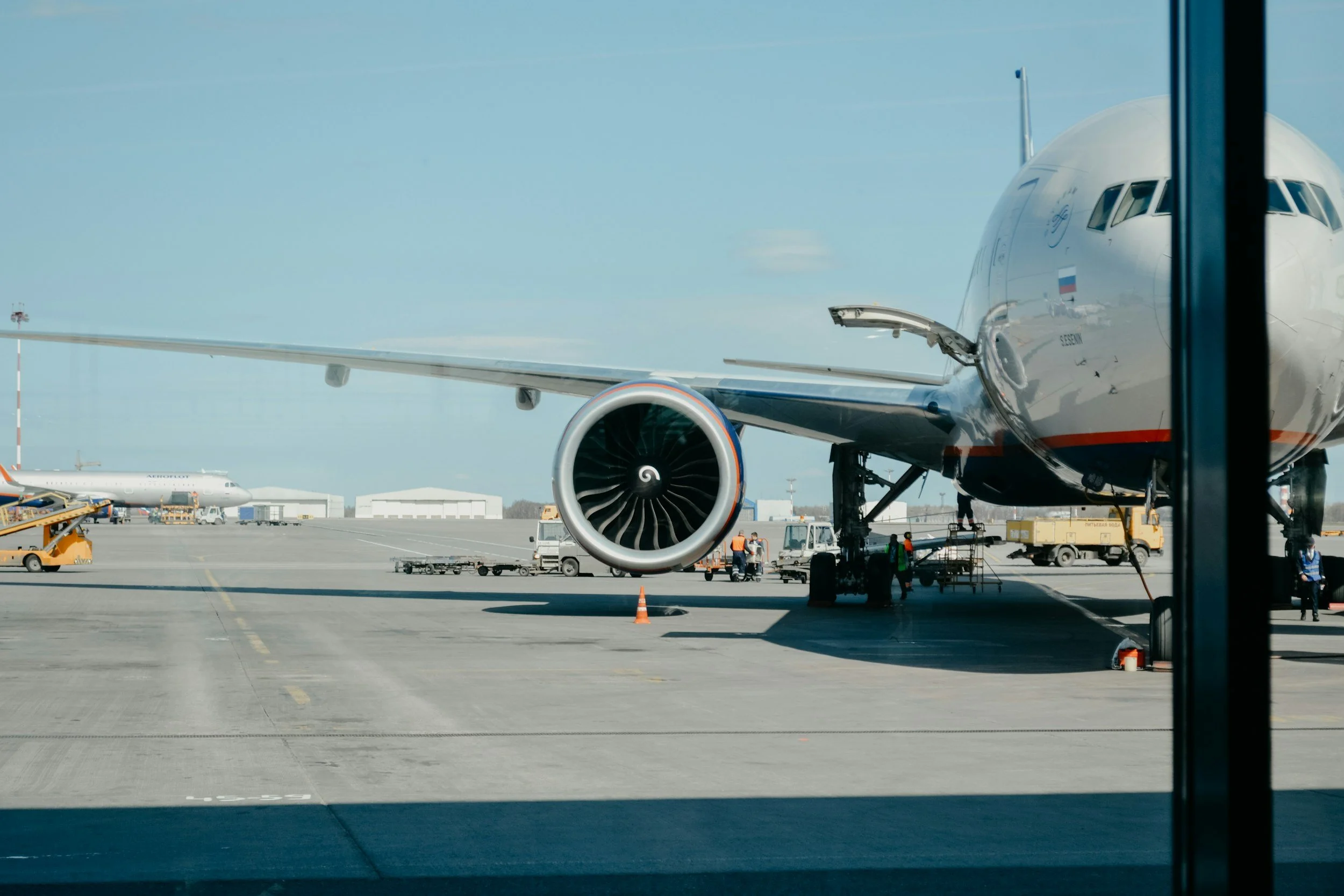
A fully loaded Airbus A380 weighs around 575 tonnes. A Boeing 787 can exceed 250 tonnes.
The important thing isn't the total weight though. It's how that weight reaches the ground. Unlike a building that spreads its load through foundations, an aircraft transfers its entire weight through a relatively small number of tyres. Those loads are highly concentrated and repeated thousands of times throughout the life of the pavement.
On a runway, an aircraft is moving quickly. Each section of pavement only carries the wheel load for a fraction of a second before the aircraft has moved on.
On an apron, the story is completely different. Aircraft taxi slowly, turn sharply, queue, park, refuel, load passengers and sit stationary for extended periods. The pavement can experience enormous, concentrated loads for hours at a time. This is why apron pavements are often significantly thicker than runways despite aircraft travelling much slower across them.
The governing design factor is not speed. It is load duration and load repetition.
The Pavement Doesn't Carry the Aircraft in Compression
Consider that a fully loaded airliner can weigh hundreds of tonnes, yet that weight reaches the ground through a relatively small number of tyres. The contact pressure beneath each wheel is immense. If the pavement relied purely on compressive strength directly beneath the wheel, the stresses imposed on the underlying layers would be enormous and localised.
Instead, the concrete pavement behaves like a massive beam resting on a foundation.
When an aircraft wheel passes over the surface, the slab deflects slightly and distributes the load outward through the pavement structure. Importantly, this load spreading occurs in two directions, meaning that a large area of concrete works together to support each wheel load rather than only the concrete immediately beneath it.
This behaviour is what makes rigid pavements so effective. The objective is not to use the concrete as a giant compression block. The objective is to mobilise a large surface area of concrete in flexure so that the concentrated wheel load is distributed over a much larger area of the supporting pavement layers.
The consequence of this is that flexural strength becomes the critical design property.
And this is where things get interesting.
A concrete mix that achieves a compressive strength of around 50 MPa will typically achieve a flexural strength of only around 5 MPa. In other words, concrete is roughly ten times weaker in bending than it is in compression.
So although aircraft pavements appear to be massive slabs of concrete, they are actually sophisticated flexural structures. Their performance depends far less on how much load the concrete can withstand in compression and far more on how effectively the pavement can bend, distribute load and control tensile stresses generated by that bending.
The Craziest Part: There Is No Reinforcement
At this point, most engineers arrive at the obvious question.
If the pavement is carrying massive point loads and relies on flexural capacity, where is all the reinforcing steel?
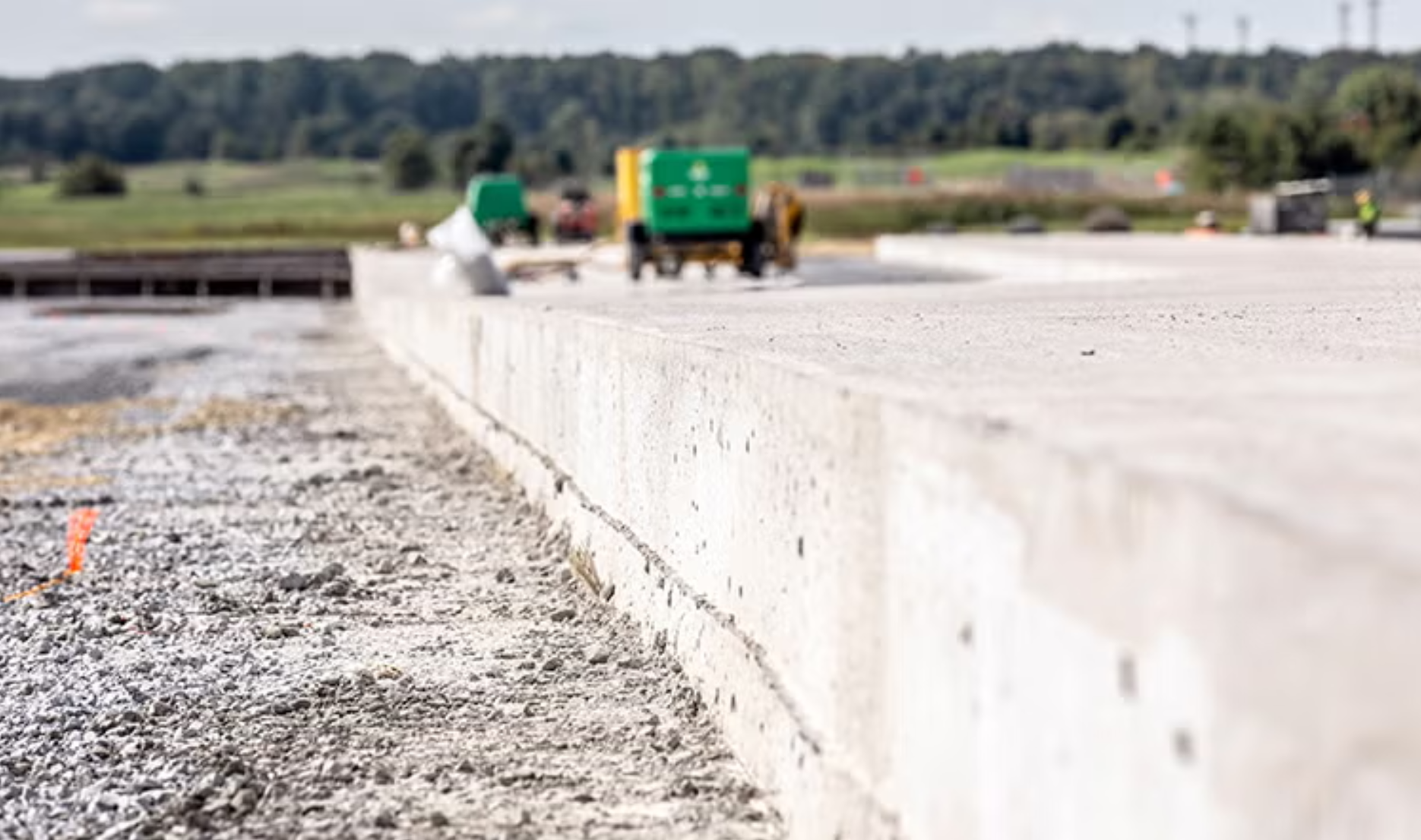
Other than steel dowels at joints, there isn't any.
Most aircraft rigid pavements are essentially plain concrete.
No reinforcing mesh.
No reinforcing bars throughout the slab.
No conventional crack-control reinforcement.
At first glance this sounds absurd. We spend our careers being taught that concrete is weak in tension and should be reinforced whenever tensile stresses are expected. But imagine the scale of an airport apron. Thousands upon thousands of square metres. If conventional reinforcement was installed throughout the pavement, the quantity of steel would be enormous. The cost, labour and construction complexity would be staggering.
So airport engineers solved the problem differently.
If There Is No Steel, How Doesn't It Crack?
The answer is that aircraft pavements don't rely on reinforcement to control cracking.
They rely on a carefully engineered system.
A Strong Foundation
Firstly, the pavement is supported by an extremely strong and highly controlled pavement structure beneath it.
The stronger the foundation, the less the concrete deflects under wheel loads.
The less it deflects, the lower the flexural stress within the slab.
Controlled Cracking
Secondly, engineers deliberately induce cracking where they want it to occur.
Shortly after placement, saw cuts are introduced into the concrete.
These cuts create planes of weakness that encourage cracking to occur in predetermined locations.
In effect, the pavement is told where to crack.
Dowel Bars
Steel dowels are installed across joints and controlled crack locations.
These dowels allow load transfer between adjacent slabs while still permitting movement.
This means that even after cracking occurs, wheel loads can continue to be distributed efficiently throughout the pavement system.
Large Aggregate
Airport concrete also typically contains larger aggregate sizes than many conventional concrete applications.
These larger particles assist load transfer across cracks and help maintain aggregate interlock between adjacent pavement sections.
The result is a pavement that can crack in a controlled manner while continuing to function as a unified structural system.
The Pavement Moves Every Day

If carrying enormous aircraft loads wasn't enough, airport pavements face another challenge.
Temperature.
Because aprons can extend across vast areas, daily thermal expansion and contraction become significant engineering considerations.
A typical concrete slab may only experience small thermal movements. An airport apron, however, can expand and contract by several centimetres over the course of a day. Movements in the order of 40 mm are entirely possible.
That may not sound like much, but for a rigid pavement it is considerable.
If the concrete was bonded directly to the underlying layers, these movements would generate additional stresses within the slab. Over time, those stresses would contribute to cracking and premature deterioration.
The solution is a debonding layer. This layer allows the concrete pavement to slide relative to the underlying pavement structure.
The debonding layer serves two important functions. It allows thermal expansion and contraction to occur freely, while also permitting the slab to flex under wheel loads without developing additional stresses from adhesion to the subbase.
Why Getting It Wrong Is So Expensive
Most road maintenance is inconvenient. Airport maintenance can be catastrophic. Closing a section of pavement may affect airline schedules, gate availability, passenger movements, freight operations and airport revenue. At major international airports, even a short disruption can have significant operational consequences.
This is why airport pavements are designed with extraordinary attention to durability. The goal is not simply to build a pavement that works today. The goal is to build a pavement that remains operational for decades with minimal intervention.
This not only impacts the design, but also the construction specification, and the scrutiny on getting it right.
The Lessons Were Written in Concrete During World War II
Perhaps the most fascinating aspect of aircraft pavement engineering is that much of the industry's knowledge was developed through observing how pavements performed in the real world.
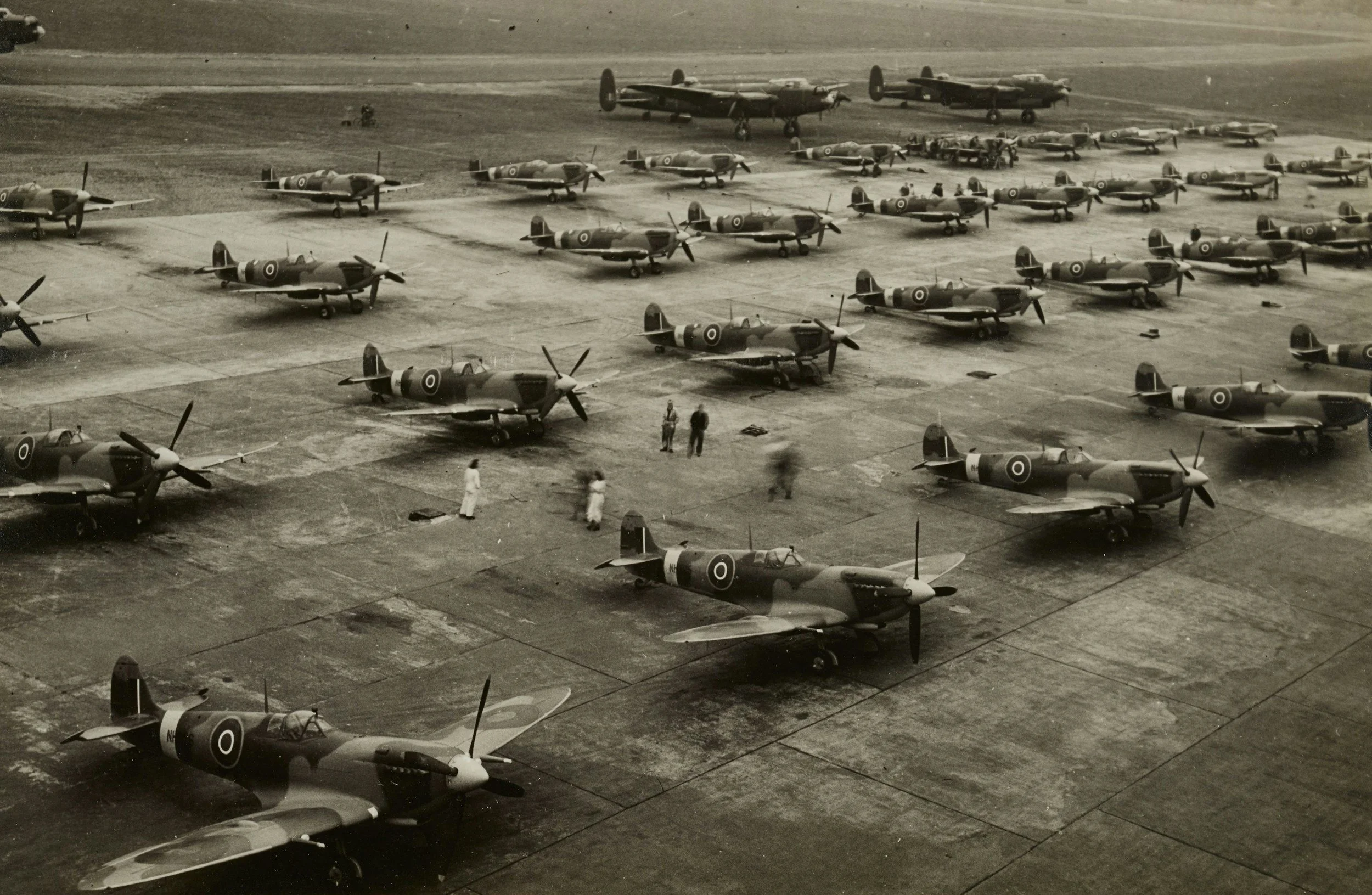
One of the earliest large-scale opportunities for this came during the Pacific campaign of World War II.
Hundreds of military airfields were constructed across islands, coral atolls and remote jungle locations under extreme time pressures. In many cases, engineers were forced to prioritise speed of construction over long-term durability. Airfields were built using whatever materials were available, construction methods were adapted on the fly, and pavements were often subjected to aircraft loads far sooner than would normally be acceptable.
While, these airfields were not the direct foundation of modern aircraft pavement design, but they provided something equally valuable: a vast collection of real-world examples showing what worked, what failed and why. Engineers gained practical insights into the importance of foundations, drainage, load transfer, construction quality and maintenance. The experience highlighted how small changes in design or construction could have significant impacts on pavement performance and service life.
The more rigorous science followed in the decades after the war. Research undertaken by organisations such as the United States Army Corps of Engineers during the 1950s to 1970s transformed many of these observations into the analytical and empirical design methods that underpin modern aircraft pavement engineering.
Today's airport pavements are therefore not simply products of laboratory calculations, nor are they solely the result of wartime experience. They are the culmination of decades of field performance, controlled research, observed failures and continuous refinement.
Read on about how to master negotiation in Construction by understanding principled negotiation rather than positional bargaining through this construction framed summary of the famous book “Getting to Yes”. Must Read for Engineers: Getting to Yes — EngiMBA