Civil Construction in a VUCA World
Civil construction faces constant disruption;
market volatility,
pipeline uncertainty,
regulatory shifts,
changing landscape of industrial relations,
technological innovation, and
global supply chain risks.
These factors create a VUCA environment where uncertainty is the norm. Traditional reactive management cannot cope. Strategic management provides the framework for resilience and sustained performance.
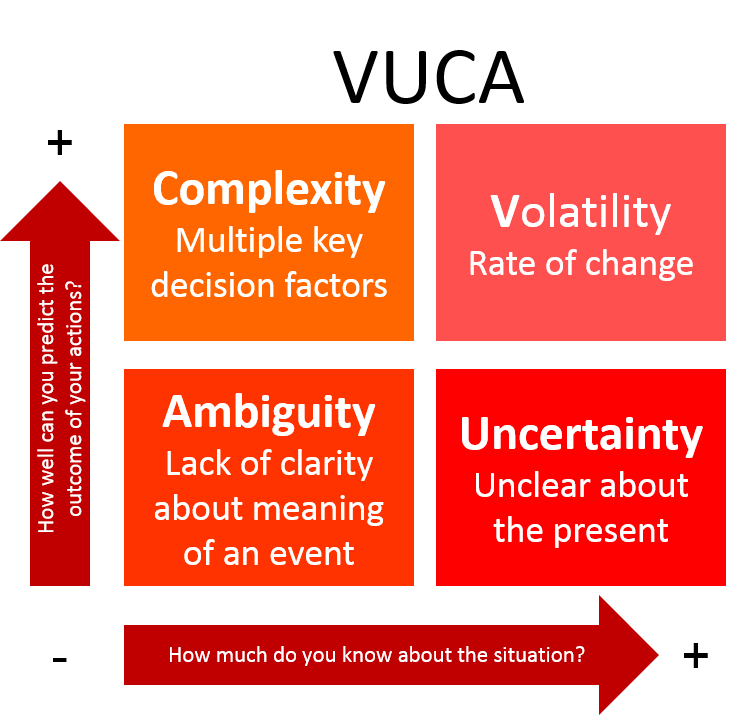
VUCA describes the modern operating environment Civil businesses face, defined by;
rapid change (Volatility),
limited predictability (Uncertainty),
interconnected systems (Complexity), and
unclear or interpretable information (Ambiguity).
Natural disasters, changes in governments, union actions, legislative changes, regulatory changes, global supply chain and currency fluctuations, all can change rapidly in an increasingly uncertain world. The difference between a business that is successful in the short term and one with decades of ongoing success is the business’ ongoing strategic management.
What is Strategic Management?
Strategic management is “a set of managerial decisions and actions that determine the long-run performance of a corporation.”
Strategic decisions occur during strategy formulation and are shaped by:
Mission – Why do we exist?
Objectives – What results by when?
Strategies – How will we achieve them?
Policies – Guidelines for decision-making.
Mission Statements, strategic goals, and policies in the construction industry are typically written by different departments for different purposes (the mission statement is written by marketing, the policies are written by legal or systems departments, and the objectives by the CFO or Operations Management). For true strategic alignment, this must all be Insync.
Why Strategic Management Matters in a VUCA World
Focuses on long-term performance.
Organisations with strategic management outperform those without.
Creates a better fit between environment and organisational strategy.
Good management will help short term performance. Good strategic management will set up a company for long term success beyond the current environment.

Mintzberg
“A strategic decision process is characterized by novelty, complexity, and open-endedness, by the fact that the organization usually begins with little understanding of the decision situation it faces or the route to its solution, and only a vague idea of what that solution might be and how it will be evaluated when it is developed.
Only by groping through a recursive, discontinuous process involving many difficult steps and a host of dynamic factors over a considerable period of time is a final choice made. “
Strategic Decision Making: The Core
Strategic Decision Making involves four key components:
Environmental scanning – Internal and external analysis. See Business Strategy in Construction - What we often miss — EngiMBA for further detail on this process and frameworks.
Strategy formulation – Long-range planning.
Strategy implementation – Turning plans into action.
Evaluation and control – Monitoring and adapting.
Many construction businesses may do this process informally but without rigour, repetition, purpose and transparency. We should treat strategic management like we do with NCRs. The process is very similar and clearly following an identical approach aids the management of the complexity over time.
Approaches to Strategic Decision Making
Mintzberg outlines three approaches to strategic decision making:
Entrepreneurial
Normally one powerful individual
Focuses on opportunities (not problems)
Bold and sets own vision
Adaptive
‘muddling through’
Reactive to problems (rather than proactive to opportunities)
Incremental decision making
Planning
Systematic gathering of appropriate information for situational analysis; generation of feasible alternative strategies; rational selection of most appropriate strategy
Proactive search for opportunities and reactive solution of problems
Quinn later added a fourth type:
Logical Incrementalism
A synthesis of planning and adaptiveness, and to a lesser extent, entrepreneurial
Management is clear as to vision and mission but strategies emerge out of debate
Entrepreneurial decision‑making represents the ideal but rarest form of strategy. As organisations scale, individual entrepreneurial capacity becomes constrained, making systematic planning essential. In a sector as persistently VUCA as civil construction, purely adaptive approaches are insufficient on their own.
Strategic Management Processes
Decision making processes regardless of type of decision are identical but taken at different levels in an organisation’s management structure.
Strategic decision making is mainly undertaken by senior/top management. Strategic decision making, in the process of strategic management, is to make a choice regarding the course of actions to adopt for the success of an organisation in the long run.
Strategic decisions relate to the choice of an organisation’s mission:
What is our business (Situation Analysis).
Where do we want to go (Formulation of Strategy).
What does this mean for our values, structures and processes (Organisation Implications).
How should we manage transition (Change Management).
How will we know how we are doing (Monitoring and Evaluation).
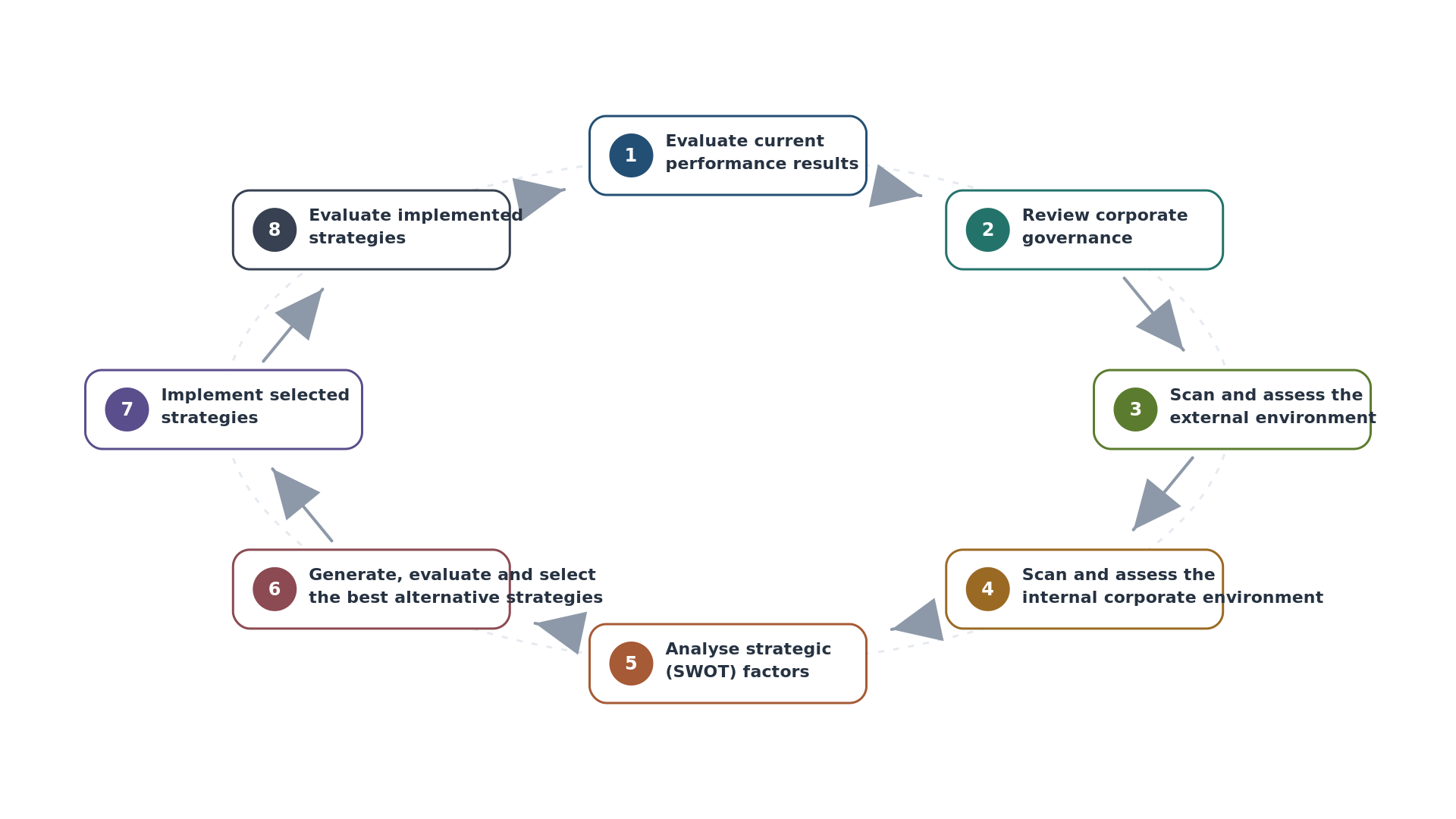
Many versions exist of such models, each incorporating a strategic gap assessment and analysis before strategic objectives are set. The following is a common process (note the similarities between this process and that of an NCR).
Evaluate current performance results
Review corporate governance
Scan and assess the external environment
Scan and assess the internal corporate environment
Analyze strategic (SWOT) factors
Generate, evaluate and select the best alternative strategies
Implement selected strategies
Evaluate implemented strategies
Evaluation and Control Process
Choosing the correct ‘measures’ for the evaluation and control process is critical – a careful selection of the right ‘measures’ is needed. Once chosen, it is critical to measure to the right standard.
Evaluation and control processes should:
Involve only the minimum amount of information needed to give a reliable picture of events i.e. the 80:20 rule.
Monitor only meaningful activities and results, regardless of difficulty in measuring.
Be timely so that corrective action can take place.
Include both short-term and long-term controls.
Aim at pinpointing exceptions i.e. results not within acceptable tolerances of the performance indicators set.
Emphasize reward for meeting/exceeding standards rather than punishment for not meeting standards.
The Strategic Gap
Strategic Gap - represents the ‘fit’ between the capabilities of the organisation and its most significant external entities i.e. the principal factors to be considered by the decision maker when making a strategic choice.
It is the measure of the ‘imperfect fit’ between the organisation and its external environment.
It comprises of 2 assessments:
Organisational assessment, and
External environment assessment, followed by an analysis of the two assessments, which is known as a situational-gap analysis
The Strategic Gap identified includes:
Positive gap – Internal strengths exceed external challenges.
Negative gap – External challenges outweigh internal capabilities.
Zero gap – Perfect alignment.
Bridging the gap requires leveraging strengths to exploit opportunities while mitigating weaknesses and threats.
If your business is more capable than the opportunities you are pursuing, you are leaving money on the table. Conversely, if you are pursuing opportunities outside of your internal capability without a define plan to develop your internal capabilities, you are setting yourself up for failure.
The Civil Construction Example
We will assume a ‘made up’ Civil Construction Company called ‘Construx’. Construx is enjoying good margin and healthy growth, and has the following attibutes:
average project size $30-$80m
typical clients: government road authorities
geographic spread: concentrated in a single Country across multiple States.
complexity is limited with typical road construction and minimal bridges etc.
Now let’s follow the strategic decision-making model:
Evaluate current performance results
Current performance results show a strong performance in the bread-and-butter type projects, and great continuing relationships with the clients. The current business strategy of targeting $30-80m road projects has developed an efficient organisation, homed in at winning and delivering these projects with excellent results. Growth is beginning to slow.
Review corporate governance
Strategic decision-making is at the executive level and largely centralised. Without all business focus currently in a define sector and market, this has been appropriate.
Scan and assess the external environment
Threats
The $30-80m market for road construction is saturated. Construx has maximised the market share as reasonably practical in this area. More competitors from interstate are entering the market, which will reduce margins.
With a new government and a focus on fiscal policy, spending cuts may result in a reduced pipeline in the $30-80m range and a larger focus on mega-projects.
A skills shortage is ramping up the war for talent, and Gen Z are showing a much higher preference to urban work over FIFO and regional.
Over-dependence on limited number of clients.
Opportunities
The Defence sector is seeing a spending boom forecasted to continue over the medium to long term.
Mega-projects and Joint Ventures are booming, especially with foreign companies looking to partner with local companies.
$150m+ project with high complexity and multidisciplinary scopes are increasing.
Scan and assess the internal environment
Weakenesses
Over dependence on a limited number of suppliers (due to long time beneficial working relationships)
Lack of diverse capabilities within the team.
Systems and processes are narrowly focussed on a limited scope and geography.
High turn-over of staff due to diversity of experience available (same types of projects).
Strengths
Low overheads due to a narrow market focus
Competitive advantage due to a well-oiled machine targeting repeatable work.
Strong relationships with clients, subcontractors and suppliers.
Analyze strategic (SWOT) factors
There are many opportunities and many threats in the external environment preventing a “do-nothing’ approach. However, the internal transformations necessary to pursue these opportunities would erode the very competitive advantage fueling the current success.
Generate, evaluate and select the best alternative strategies
Doing nothing - maintaining the current strategy would not yield the same returns into the future. Continued growth would not be possible without expanding geographically, or by project scopes, size or clients. Furthermore, a lack of growth in a high performing team will lead to a lack of opportunity for upwards mobility, leading to the loss of key staff over time.
Go for the opportunities - to expand into different project types and sizes or even geographic regions, an internal transformation would be required. The systems would need to be geared to be more vague to be applicable to various project types and sizes. New hires with diverse experience would be required to perform in the new project types and/or sizes. New upper management (overheads) would be required to handle the influx of new clients, geographical locations and more. This would both increase the overheads, and reduce the efficiency of the “well-oiled machine”.
Any appropriate strategy would require full commitment.
Commit to a narrow scope - To maintain the current strategy and accept a low-growth, high margin type business; Construx should invest into systemising the processes in the narrow scope, and double down on efficiency. Furthermore, by dramatically systemising the management of projects, the learning curve for new starters will be lower. The business can then target skilled visas applicants looking for initial work experience. This would keep overheads low and create another competitive advantage in the war for talent during the skills shortage crisis.
Split the business into two - Maintain the “well-oiled machine” as its own business, “Construx - Roads”, and launch a new business called “Construx - Major Projects”. The two businesses will share all HR, Accounting, Finance, Legal, and executive overheads; with tendering and operations being company specific. this will allow the core business to continue running unencumbered, and the new business to target the new work unencumbered. While this is the most efficient way, it will still add net overheads due to added complexity. So the business must fully commit to a growth strategy of the new business to make it worth it.
In this example, we will assume that option 1 “Commit to a narrow scope “ was chosen by management.
Implement selected strategies
Implementation is where strategy succeeds or fails. For Construx, committing to a narrow scope requires reinforcing what already works while deliberately removing unnecessary complexity.
The core focus is systemisation—standardising end‑to‑end delivery processes for $30–80m road projects to reduce reliance on individual experience and improve repeatability. This allows faster onboarding, lower overheads, and more predictable outcomes.
Organisationally, roles and decision rights are simplified, management layers are minimised, and incentives are aligned to efficiency and consistency rather than growth. Workforce strategy prioritises rapid capability development, retention, and reduced dependency on scarce senior talent—positioning Construx to compete on learning speed and certainty, not scale.
Clear leadership communication is critical so the strategy is understood as disciplined focus, not stagnation.
Evaluate implemented strategies
The success of this strategy cannot be measured on revenue growth alone, as external market pressures will distort results. Evaluation must instead focus on controllable indicators.
Key measures include:
Delivery consistency: margin and programme reliability
Efficiency: overheads as a percentage of revenue
Capability depth: reduced single‑point dependencies
Workforce stability: turnover and internal progression
These metrics show whether systemisation is working and whether the strategic gap is stabilising or widening.
Evaluation must be conducted regularly and feed directly into refinement of systems and governance. Strategic management is not a one‑off decision—it is a continuous closed‑loop process of action, measurement, and adjustment.