ROI on AI isn’t driven by the Tech; It’s Driven by the Humans using it - What this means for Construction
Why enterprise adoption, not model capability, will determine who wins
At CommBank’s Accelerate AI summit in Sydney, one idea cut through the noise: the biggest constraint on AI today is no longer the technology, it is the organisation.
Sam Altman put it plainly.
AI capability is already “reasonably advanced,” but enterprise deployment remains “quite early.”

Sam Altman at the Commbank Accelerate AI Confrence
That gap between what AI can do and what organisations actually use it for, is now the defining challenge for leaders.
The Adoption Gap Is Real and Expensive
Across industries, the same pattern is emerging. AI systems can already perform far more tasks than companies allow them to. Research consistently shows that:
AI capability is advancing rapidly across cognitive and professional tasks
Most organisations are still stuck in pilot mode or limited deployment
Enterprise-wide value is not yet being realised at scale [mckinsey.com], [forbes.com]
This is not a technology failure. It is an adoption failure.
Even when tools exist, organisations struggle to:
integrate them into workflows
trust outputs reliably
redesign roles and processes
scale usage beyond early adopters
The result is billions in investment with limited realised productivity.
The Iceberg Beneath the Surface
MIT’s Iceberg Index provides one of the clearest explanations of this gap.
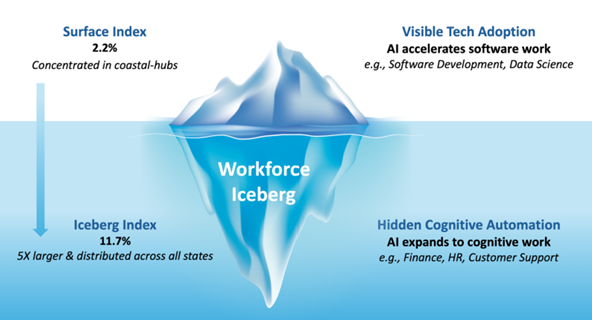
The research shows that visible AI usage, the part we see in headlines and tech roles, represents only a small fraction of its potential.
Visible adoption: ~2.2% of wage exposure
Underlying capability overlap: ~11.7% of work tasks [iceberg.mit.edu]
In other words, most of AI’s impact sits below the surface. The implication is profound:
AI capability is already deeply embedded across the economy but organisations have not absorbed it yet.
The answer isn’t more powerful models, it’s better adoption.
Why Adoption Is So Hard
There are three structural barriers most organisations underestimate:
1. Workflow inertia
AI doesn’t plug neatly into existing processes. It cuts across them.
Real value requires redesigning workflows, not just adding tools.
2. Trust thresholds
Even highly accurate systems require verification.
Until organisations are comfortable delegating decisions—not just drafts—adoption stays shallow.
3. Leadership lag
Technology evolves monthly.
Organisations plan annually. As Altman warned, traditional planning cycles are struggling to keep up, forcing leaders to “adapt as they go” rather than wait for certainty.
How does this relate to Construction?
The construction industry is widely recognised as one of the poorest performers in productivity and innovation. Paradoxically, in the age of AI, that may become an advantage.
Unlike more digitally mature industries, construction is not constrained by decades of entrenched IT systems or the sunk cost fallacy. In many ways, it remains a blank canvas, an opportunity to design AI-enabled workflows and operating models from first principles rather than retrofit them into legacy environments.
However, the challenge is not technical, it is cultural.
Construction has been built on:
controlled risk environments
low tolerance for uncertainty
traditional project management frameworks
centralised decision-making structures
These characteristics, while effective for delivering physical assets, are fundamentally misaligned with how AI drives value.
AI adoption does not succeed through top-down control alone. It requires broad-based experimentation across the entire organisation. The most valuable use cases are rarely identified in boardrooms, they emerge from the front line, where people understand the real friction points in workflows.
In practice, this means:
generating a large volume of ideas
testing them rapidly in low-risk environments
identifying what works
and then scaling only the most impactful use cases
Most ideas will fail. That is expected. For every 100 experiments, only a handful may deliver transformative value. The mistake is not failure, it is not running enough experiments to find the winners.
Equally, simply rolling out AI tools is not enough. Without AI literacy and cultural alignment, adoption will remain shallow. The capability of the technology is already there. The limiting factor is whether the organisation knows how (and is willing) to use it.
This creates a clear leadership mandate:
Invest in AI literacy across the workforce
Create safe “sandpit” environments for experimentation
Empower teams to explore use cases, not just follow directives
Encourage risk-taking within controlled boundaries
AI is not a single solution, it is a capability with millions of potential applications. No central function can identify all of them.
The role of leadership is to set direction and enable the environment.
The role of the organisation is to discover the opportunities.
To read more about how to build an AI culture in your business, read Maverickism: The Key to Innovation in the Construction Industry - with Dr. Ree Jordan — EngiMBA