Program Meetings & The Vertical Slice Technique
Effective program meetings are the backbone of successful construction projects. These meetings provide a vital opportunity to ensure all team members are aligned and working cohesively toward a common goal. Every day, each team member focuses on specific tasks and accumulates unique insights about the project's progress. Program meetings bring these varied perspectives together to create and—more importantly—evaluate an actionable plan for moving forward.
To make the most of program meetings, consider these essential principles:
1. Keep Meetings Short
Long-winded meetings can drain productivity, pulling team members away from their core tasks. Keep meetings concise and focused to maintain efficiency.
2. Maintain Consistency
Schedule meetings at the same time every week, allowing team members to plan their work around them. While it might be tempting to delay a meeting for additional information, it's better to proceed with the knowledge gathered over the past week. The lookahead program is dynamic and evolves as new information arises. However, holding program meetings consistently ensures that your planning rhythm stays intact.
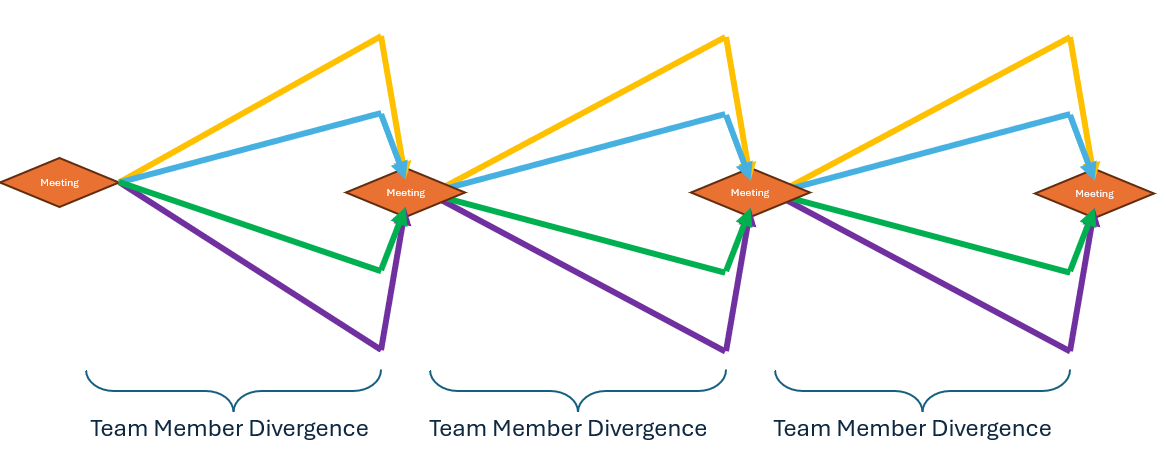
3. Keep it Structured
The meeting chair must ensure discussions stay on track. Meetings shouldn't attempt to solve every issue immediately. If a problem can't be resolved quickly, document it as an action item and assign responsibility for its resolution.
4. Who Should Be There?
Be mindful of everyone’s time. Involve only the essential personnel—such as supervisors, project engineers, key subcontractors, and suppliers—while allowing others to remain in the field to keep the work progressing.
The Vertical Slice Technique
One effective tool for evaluating your program is the vertical slice technique. This simple yet powerful method ensures a sanity check of your construction plan.
How does it work?
Review each crew’s tasks for the upcoming week.
Analyze each day, “slicing vertically,” and ask: Can these activities happen concurrently?
For example, see the example program on the whiteboard. Presumably, the Supervisor for the earthworks, the Supervisor for the FRP Subbie, and the Leading Hand looking after the conduit install have all contributed their planned works for the upcoming week.
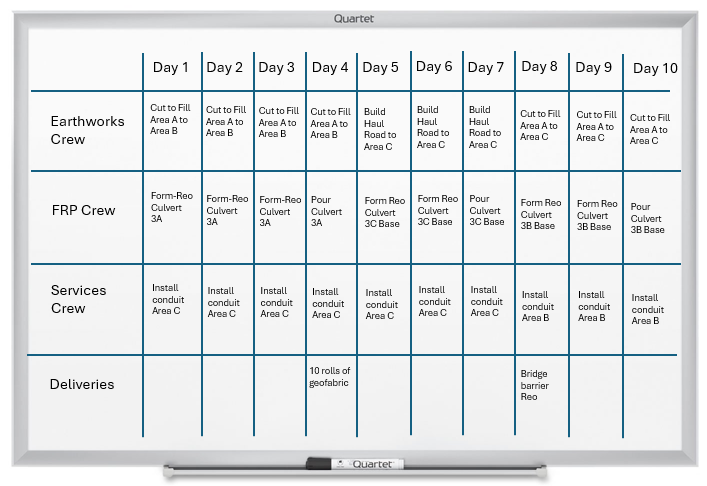
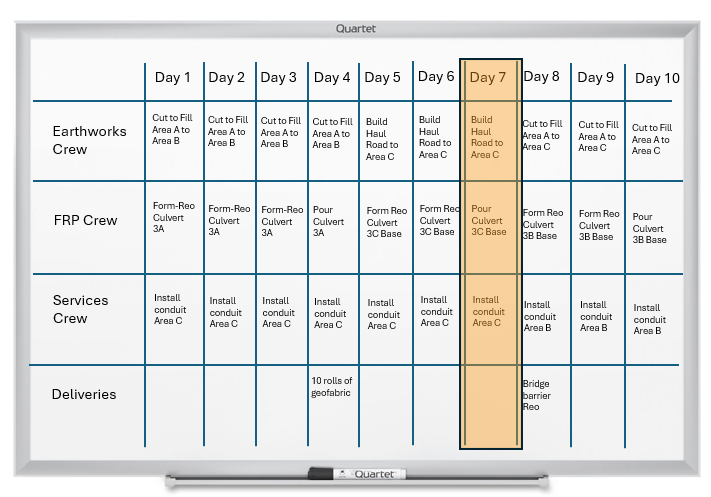
Each of these plans have been developed in isolation, and it hasn’t been evaluated for conflicts. It is therefore necessary to take a ‘vertical slice’ and view each day individually to check for conflicts.
In this example, it can be seen on Day 7 that the Earthworks crew is finishing the construction of a haul road to Area C, while the FRP Subbie is pouring a culvert in Area C, and the Services crew are also installing services in Area C. This is a fair bit of congestion in the one area, and the following questions should be asked:
Can the concrete truck access the culvert with the conduit trenching and haul road construction?
Does the pour require a concrete boom pump? If so:
can it access?
will the pump exclusion zone cut off access for other activities?
Will the vibratory compaction with the haul road damage the early age concrete?
Could the earthworks crew start the haul road construction at the other end, so they will be further away from the other activities by Day 7?
The Vertical Slice technique is essential for deconflicting concurrent activities in advance, rather than just dealing with the problem on the day. This simple example illustrates the power of taking the vertical slice in the weekly lookahead meetings. However, this tool can be used on all programs of all sizes. Using the vertical slice on the master program may point out that commencing the bridge too early may double the length of the haul route. Even on the scale of a city-wide portfolio of projects, the vertical slice technique may highlight a train and bus station closing simultaneously in a neighbourhood.
Next time someone prints you the master program or the 4WkLA, take out a ruler and start taking vertical slices. It may just save you a headache down the road.
Communication: Transparency is Vital
Too often, engineers treat the lookahead program as proprietary information. Transparency is essential—share the program widely with your team, which includes inspectors, surveyors, geotechnical testers, key subcontractors, and suppliers. Providing this clarity ensures everyone is working toward the same goals. Remember, withholding information doesn’t increase importance; it only creates bottlenecks in information transfer.
Preparing for Success
Preparation is the cornerstone of achieving your program goals. Ensure you address the following:
Do you have approvals for:
Inspection and Test Plans (ITPs)
Construction procedures
Safe Work Method Statements (SWMSs)
Materials
Designs
Hold points
Land agreements
Permits
Have you booked:
Supplies
Subcontractors
Inspections
Finally, always ask: What could prevent us from achieving this program? By identifying potential obstacles a week or two ahead, rather than on the day of execution, you can mitigate delays and maintain momentum.
By adhering to these principles and practices, you’ll create a well-oiled planning process that aligns your team, optimizes productivity, and ensures seamless project delivery.